Roger Courtney and a Watery Gamble - The Establishing of the SBS
Described by the BBC as the "Shadowy sister of the SAS", The Special Boat Service (more
commonly known as the SBS) is likely one of the most well-trained and elite special forces
units around today that few in the world have ever heard of, despite performing countless
harrowing missions, dozens of hostage rescues and more than its fair share of daring night
time raids going all the way back to WWII when an officer by the name of Roger "Jumbo"
Courtney risked a court-martial to demonstrate to his superiors just how valuable a unit
like the SBS could be.
Little is documented about Courtney's life prior to his military service in WWII other
than that he was an avid big game hunter and adventurer in Africa for a number of years.
This is particularly important to the story at hand as he often regaled his fellow soldiers
with stories about hunting lions and other big game in a canoe.
When Courtney heard about the outbreak of WWII, he returned to Scotland and enlisted
in the military; sometime in 1940, he began serving with the now defunct No 8 Guards unit.
Almost as soon as he became a commando with the No 8's, Courtney managed to score a
meeting with the Admiral of the Fleet, Roger Keyes.
In the meeting, Courtney tried to sell the sceptical Admiral on the benefit of using
canoes to quite literally "hunt Germans".
He argued that small, collapsible canoes could be used to silently sneak where powered boats
could not.
Keyes summarily dismissed Courtney's proposal, stating that canoes were better suited for
the boy scouts than the army.
Undeterred by Admiral Keyes' lack of vision, Courtney arranged for a meeting with another
high-ranking military official, Admiral Theodore Hallett, in the hopes that he would see the
benefit of the proposal.
Like Keyes, Hallett dismissed Courtney's idea outright.
Frustrated with how quick his superiors had been to dismiss his proposal, Courtney, later
described by Major David Sutherland as "a hard-drinking white hunter with a big line
of bullshit and a persuasive tongue", came to the conclusion that the only way to prove
that his idea could work was to put it into practise.
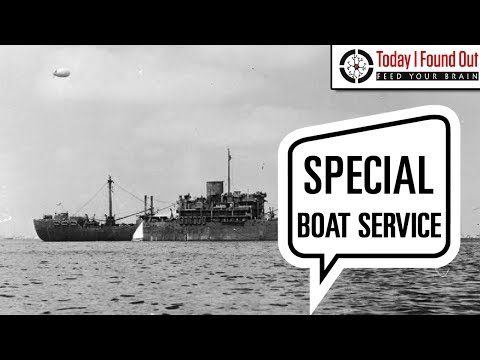
HMS Glengyle HMS Glengyle
Four days after his failed meeting with Admiral Hallett, Courtney silently paddled a canoe
along the River Clyde and stealthily climbed aboard the HMS Glengyle.
Once aboard, Courtney sneaked his way to the Captain's quarters and scribbled his initials
on the door.
Just for good measure, before leaving he stole one of the ship's deck gun covers, which
had the ship's name on it.
Courtney then slyly slipped away undetected and made a beeline for the nearby Argyll Arms
Hotel where he knew Admiral Hallett was currently meeting some military bigwigs.
Once there, Courtney waltzed up to Hallett's private room, reportedly dressed only in a
pair of swimming trunks, barged in and proudly proclaimed that he'd just managed to sneak
aboard the Glengyle and make it to the captain's quarters unmolested.
When the captain of the Glengyle, who just so happened to be present at the meeting,
scoffed that his ship could be infiltrated in such a way, Courtney unrolled the deck
gun cover and placed it on the table.
Although Courtney had committed a potentially court-martial-able offence, as well as risked
getting himself mistaken for an enemy and shot during the infiltration of the Glengyle,
the fact that he'd been able to do this and make it to the captain's quarters without
being spotted during war time while half naked to boot, so impressed his superiors that they
reconsidered their stance on how effective soldiers with foldable canoes could be.
SBS-canoeAfter his stunt, Courtney was asked to provide another demonstration, this time
sanctioned, infiltrating a submarine depot ship.
When that was successful as well, he was promoted and given command of 12 men, who he then trained
in clandestine operations and the use of the "fol-boat", a collapsible canoe made of
rubber and wood that could be assembled or broken down rapidly.
The "fol-boat brigade", as it was then known, carried out numerous missions during
WWII, most notably paddling into an enemy port near the mouth of the Gironde and destroying
several key ships harboured there in an operation that Winston Churchill claimed accelerated
the end of the war by "six months".
As for Courtney, despite being highly involved in the gruelling training of the first waves
of SBS commandos, he wasn't with the force very long, having to return to the U.K. due
to health issues.
He was ultimately relegated to a desk job and died just a few years after the war ended.
Today his legacy lives on in the form of one of the most highly trained and terrifyingly
effective units of soldiers on Earth.
To join either the SAS or SBS you have to pass an infamously brutal and unforgiving
selection process which involves a month of gruelling physical exercise culminating in
a 40 km march across the harshest terrain Britain has to offer.
Nine weeks of training in the jungle.
Fourteen weeks of training in demolitions, reconnaissance and a variety of other advanced
combat tactics.
The process then culminates in something known as "Survive, Evade, Resist, Extract" training
which involves releasing the recruits into the woods where they are hunted down by Royal
Marines who will then interrogate them for several weeks using sleep, food, water and
sensory deprivation.
If a recruit fails during any one of these or gives any answer other than their name,
rank, date of birth or army number, during the interrogation process, they will fail.
Additionally, recruits hoping to join the SBS are required to undertake several more
months of water-based training which involves learning how to do such amazing things as
infiltrate and exit submarines while they are submerged, and diving out of planes into
freezing cold water in near zero visibility.
Unsurprisingly, over 90% of recruits who apply for the SBS or SAS fail.
Recruits hoping to join the SBS or SAS can only apply a maximum of two times before they're
barred from ever trying again.
The SBS and SAS work in alternative six month long shifts, during which they will train
constantly to keep their skills as sharp as possible.
These training sessions are understandably rather secretive, but are known to involve
live fire trainings exercises and mock raids on potential terrorist targets to test their
security.
In one such mock raid, members of the SBS broke into a nuclear power plant in Scotland
in less than a minute, exposing various issues with security at that plant.
In regards to live fire training exercises, both the SBS and SAS are said to always train
using live ammo and often use real people as hostages.
The SAS in particular is known to invite foreign dignitaries to take part in these exercises
to demonstrate their skill and composure.
For anyone wondering about the difference between the two units, while both the SAS
and SBS are fairly analogous in terms of their reputation, skill and basic training, as their
names would suggest, the Special Air Service specialise in aerial combat and parachuting,
whereas the Special Boat Service has an affinity for water-based and amphibious combat.
That said, the SBS has been known to take part in land-based missions when the need
arises and vice versa.
Both units also set aside a small, constantly rotating contingent of men for counter-terrorism
duties who are on call 24 hours a day, 365 days a year.
Despite their close proximity to one another, the relationship between the SBS and SAS is
a notably chilly one with both units displaying various levels of animosity towards one another.
 For more infomation >> Albert Hammond - The Free Electric Band (ZDF-Fernsehgarten - 2017-06-04) - Duration: 4:28.
  For more infomation >> Quim Arrufat a Proposició llei orgànica competència per referèndum futur polític de Catalunya - Duration: 15:13.
 For more infomation >> Padres, son todos iguales - Campaña de captación de soci@s Fundación Iguales - Duration: 0:28.

 For more infomation >> Face the Nation 6/4/17 | CBS News June 04, 2017 - Duration: 45:01.
 For more infomation >> Prenez ceci pendant 4 jours et débarrassez vous de la graisse du ventre, dos, cuisses et des bras ! - Duration: 4:15.
 For more infomation >> douceur - Duration: 7:16.
  For more infomation >> Un comportementalise équin. Pourquoi faire? - Duration: 6:05.


No comments:
Post a Comment