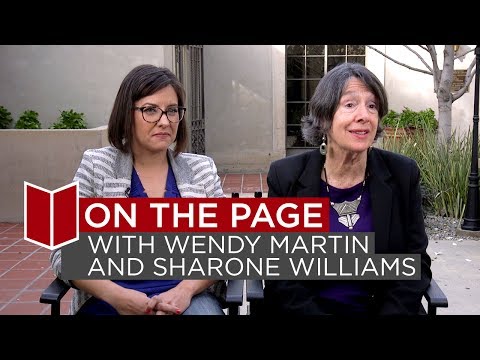
- The book we're talking about is the
Routledge Introduction to American Writers
and on the cover as you can see is Emily Dickinson
and then Toni Morrison.
And Sharone and I had many discussions about this, many.
And then we decided that Emily Dickinson represents
a writer who again was fiercely devoted,
passionate about her poetry
but was definitely writing against the grain.
I mean she had very little support,
to the extent that even when she inquired
of Thomas Higginson about the possibility of publication,
he made it clear that it was too soon,
premature for her to think of publishing
and she regrouped and took it well.
I think it was insulting beyond belief,
but she befriended him
and they were lifelong friends, certainly.
But she stood out I think because she
didn't let go of her sense of what she wanted to do.
She was fierce in her concentration
and her desire to keep on writing no matter what,
and that took amazing, amazing courage
and amazing commitment.
So she really wasn't discovered until
well after she was dead and I would say
she has never received the kind of attention
that she has in the last five or 10 years.
She was a middle panel of one, my first book
American Tryptic in which I outlined
very very carefully this process of how she had
to kind of pull herself together
after an initial disappointment
and prevail, and she was not afraid
to rebel against her father, against religious authorities,
against traditional standards of sentimental poetry
and she persisted.
So we put her there because of that
extraordinary independence and
as I said fierceness of commitment.
And I would say Toni Morrison for similar reasons.
Dickinson was writing at a time
when women really weren't supposed to write
in a kind of bold and brave way,
and Toni Morrison was writing about matters of race
and changing our notions of narrative,
narrative structure just as Emily Dickinson
changed our notions of poetic structure.
Emily Dickinson abandoned rhyme,
Toni Morrison abandoned a kind of strict adherence
to linear plot, but also brought in
so many more voices which Sharone will talk about
than we had ever heard before really,
or very rarely heard from.
- Toni Morrison has this career
that has A, spanned decades.
I mean, a good chunk of the 20th Century
and the 21st Century so far so there's
that part of it as well and all of the acclaim
and all of those things, and she's also become such a voice.
She's a public intellectual now as well.
She's so much more than, well for people
who know who she is, so much more than a writer of novels,
or a writer of theory.
I mean she's been a professor and all these
other kinds of things, but she was also
when she was working as an editor,
paved the way for so many other writers
and really did a huge thing to sort of
break apart publishing and make it,
I mean frankly make it less white.
Which was one of the major battles
of the sixties and seventies.
I mean and continuing to this day, it's far from over.
So, so in terms of people who have had huge impact,
she's certainly someone who has had huge impact.
As a literary, as a writer and as an innovator artistically,
but also as a figure in American culture.
- Over the years, the participants,
that is the women writers themselves
have become so much more diverse,
so much more complexly located in the culture
that we thought there would be a need to rebalance
what has been traditionally thought of as the canon
that is the sort of major women writers or the canon
is supposed to be the greatest, you know the best
and so on and so forth, but there's so many new voices
and so many important works that haven't been
accounted for that we wanted to put those works
in the tradition of the canon itself.
And Sharone is someone who really knows a lot
about multicultural literature, I think that's safe to say.
And really has a passion for creating
that kind of equal perspective, equal treatment
of this wide range of writers.
- One of the things that was really important to me
as Wendy mentioned was that the canon,
it's not that it's, there's just so much more
that can be included and the opportunity
to bring some of these new voices in
and bring them into conversation in ways that,
and to almost to present them
in a way that didn't call attention to, but sort of
was able to reorient the way that we look at
these texts together was a really exciting opportunity.
Because nobody really knows this history
and there's so much, if you look at
the record the record is incredible.
But one of the things that even
since we've written it that has seemed even more urgent
is that we're in this moment historically now
that it seemed urgent when we were writing the book too,
but it seems even so much more urgent now
is that this question of what does it mean to be an American
and what which is one of the main projects
of American literature.
This is what literature is answering,
and women have always been a part of that conversation,
but they haven't always been a part of the way
we've talked about the conversation.
So that, so it just seems essential now
to look at the record and see that
American women have always been part of these movements
and that American literature has always been
multi-ethnic and multi-racial and gender diverse,
it always has been that way.
It's always been the writing of immigrants, always.
It has always been, there have always been
queer and bisexual and lesbian and trans women
who have been part of these traditions.
Women with disabilities, many women with disabilities,
part of these traditions and also women
from a range of spiritual traditions
and religious traditions.
- And I would say that continuity is crucial to understand.
I think that's something that
very few people really take in.
For example I don't think most people even academics,
even specialists in American literature
realize for example what an important impact
Puritan literature and culture and religion had
on American culture in general.
Those ideas have been taken, secularized, but nevertheless
they're structurally very much the same.
So that as Sharone says, there are writers of all ages,
of all colors, of many many backgrounds,
but if you even take a canonical writer
like Anne Bradstreet, her concerns and her preoccupations
we see reflected in poetry and literature today.
And Bradstreet I mean arguably
is our first American women writer.
Puritan, came over from England with her father
and her husband.
They had lived on the earl of Lincolnshire's estate.
She was used to a rather aristocratic life.
She had the run of the earl's library.
She comes to the new world, and she said her heart rose.
I mean there were no streets, there were muddy paths,
there were you know not any of
the amenities she was used to.
But she was a committed writer, even from the beginning,
even as a young girl.
She got here and of course women weren't supposed to write.
I mean it really was an era when especially in New England,
women were supposed to be seen and not heard
but she wrote and she continued to day and night,
you know dark hours of the early morning and so forth
and then actually produced The Tenth Muse
which is the first book by a woman
published in the United States.
And yet she couldn't say here's my book,
I want a publisher to publish it.
Her brother in law had to take it to England,
find a publisher, and Anne Bradstreet had to
take the role of oh well, I just do this in my spare time
and he had to make it clear that
she didn't take any time from her family.
So already she was set up as a second class citizen
and she was, had many advantages
and then there were many other writers
who certainly didn't have the advantages of Bradstreet
who also wrote and who maybe took a little longer
to be discovered, but were certainly
part of that literary community.
- Certainly women's writing has mostly been
very remunerative for their publishers, at least.
But it has to be sort of masked in certain ways.
It has to have this introduction by these male poets
like Anne Bradstreet, in her edition saying
well she's, you know she's still a very modest woman.
She's not overstepping her bounds,
or it has to be a religious text
or meant to instruct children
or meant to have some kind of moral lesson, and women
often found an opportunity for those kinds of things
through reform and through protest.
That has been an important, incredibly important part
of how women had access to the literary marketplace.
- And I'd like to say that dynamic
of protest and reform is a deeply American value.
I think it's fair to say that just about every movement
has taken place by a group separating
and then defining an identity,
putting it forward in the public arena,
and then moving on.
So it's always a matter of kind of
working against the grain, writing against the grain,
and I think Sharone is absolutely right.
That is what most women are doing
in really over a several hundred year period.
And I think we don't often realize
the importance of the protest in reform dynamic.
I think that we see it today in our politics,
it's just obvious, and there are many many groups
and you wonder sometimes if they could ever
pull together and find common ground,
but it happens, it does happen
and it is requiring though a process of differentiation
and solidification of an identity
and then there's a kind of coming together,
and women have really been
very, very much a part of this process.
- One of our priorities in this book
was to, to as we said before
to kind of to bring some kind of balance
that maybe hadn't necessarily been present
in the canon before, and in a book of this size,
I mean you're covering 300 and some years,
real estate is of course prime.
Like that's the biggest challenge
is who do you allocate space to and how?
And so trying to balance the canon
with all these people that you have to talk about.
You can't ignore Edith Wharton, not that you would want to,
but you can't ignore, you know you can't ignore
Harriet Beecher Stowe, you can't ignore all the people
that we've been talking about for decades,
but we also wanted to bring in other people
who deserved to be in that place as well.
And who haven't necessarily been placed
on the same footing, or who have been broken
into too many categories right?
So part of the project was giving,
trying to give equal place to all of these figures
that we felt deserved to be included
that maybe hadn't necessarily and putting them
in conversation in ways that
we hadn't necessarily seen before.
- In some sense, the vision of this book is corrective,
but I want to put this in historical context.
When I was a graduate student, no one taught women writers.
I had nothing, never once.
One woman writer in any of my seminars.
Not Willa Cather, not Edith Wharton, not any of,
not Emily Dickinson even.
So I think you have to really understand
what a long way we've come in really a very few decades
in terms of bringing women writers to public consciousness.
As Sharone says, rebalancing, giving weight
to some of the writers we've never heard of is important.
Now in the long run, that is not to say
that because we know history is a kind of,
a pressure cooker and a condensing kind of discipline
and over time many people drop out.
There's, I mean we know Shakespeare.
We don't know, most of us, many of his contemporaries.
Shakespeare has lasted.
400 years from now, perhaps they'll remember Emily Dickinson
perhaps Edith Wharton or Willa Cather,
but they will know that it was
a very complicated literary ecology.
And in this process of rediscovery,
and reassessment we discover writers
who really are brilliant who just for one reason
and another got overlooked in this sort of political,
as I said, pressure cooker.
So I think in order to appreciate this book,
you have to realize that this information,
this knowledge was simply not accessible
even three decades ago.
And this is an effort to bring all the material forward,
put it in perspective as seems appropriate,
and then future generations will go and reassess
and reassess and that's what scholars do.
- And they'll move the bar somewhere else.
- That's right.
- They will discover new texts and find
their own priorities and I mean if you think of
your generation as the generation that comes before mine,
you know that what you guys did was
you know beginning 30 and 40 years ago
to bring all of these things to light
and bring these works that we do have Willa Cather,
we have a canon of women writers
so that I didn't come into school,
no we still read mostly men in many of my classes
but I didn't come into school
never having heard of a woman writer.
I discovered Anne Bradstreet in high school
and you know was wowed by it.
I didn't discover Jane Johnston Schoolcraft.
Now maybe, maybe the generation that comes after me will
which would be incredibly exciting.
- I think we don't realize that writers
are really a product of their time
and they speak to other generations
sometimes more loudly, sometimes softly,
and it is unpredictable, but what we do know
is they keep on writing, they persist over time.
There's a commitment to survive, to prevail,
and I think it's fair to say, I think it's fair to say
that the canon is much more balanced
because of women's studies programs,
because of professors like me who
were part of the second wave of feminism
and really learned a lot about what was lost
in the literary tradition, who went to the archives,
found writers who had been just sidelined
and shelved you know way in the back
and made them available to subsequent generations.
But I think you cannot divorce yourself
from gender or race, class,
in this political and historical context.
Maybe in 100 years, I'm beginning to think no
but I thought so once.
I mean I was thinking that a few months ago maybe
but I think it's going to take longer than I even imagined.
And it won't probably happen in my lifetime.
Although that said, I think women have made enormous strides
and as we have just said, Toni Morrison
is probably the best living American writer.
That's an enormous step forward, enormous
and you can't take that away.
- Yeah.


 For more infomation >> Audi A1 1.4TFSI S-LINE 92KW SPORTBACK - Duration: 1:00.
  For more infomation >> Audi A4 Avant 2.0 TFSI Sport S-tronic Automaat Sportstoelen Xenon 190PK - Duration: 0:58.
 For more infomation >> Ed Good, Rocko Bad / Tee'd Off - Duration: 24:27.
  For more infomation >> 1979 High School Wrestling Movie Weigh Ins Cont'd & Matches w/ Nice Pins & Biting - Duration: 8:02.

 For more infomation >> Even small amount of alcohol can cause fetal alcohol syndrome - Duration: 2:08.
 For more infomation >> Nothing to Sneeze At / Old Fogey Froggy - Duration: 25:51.


No comments:
Post a Comment